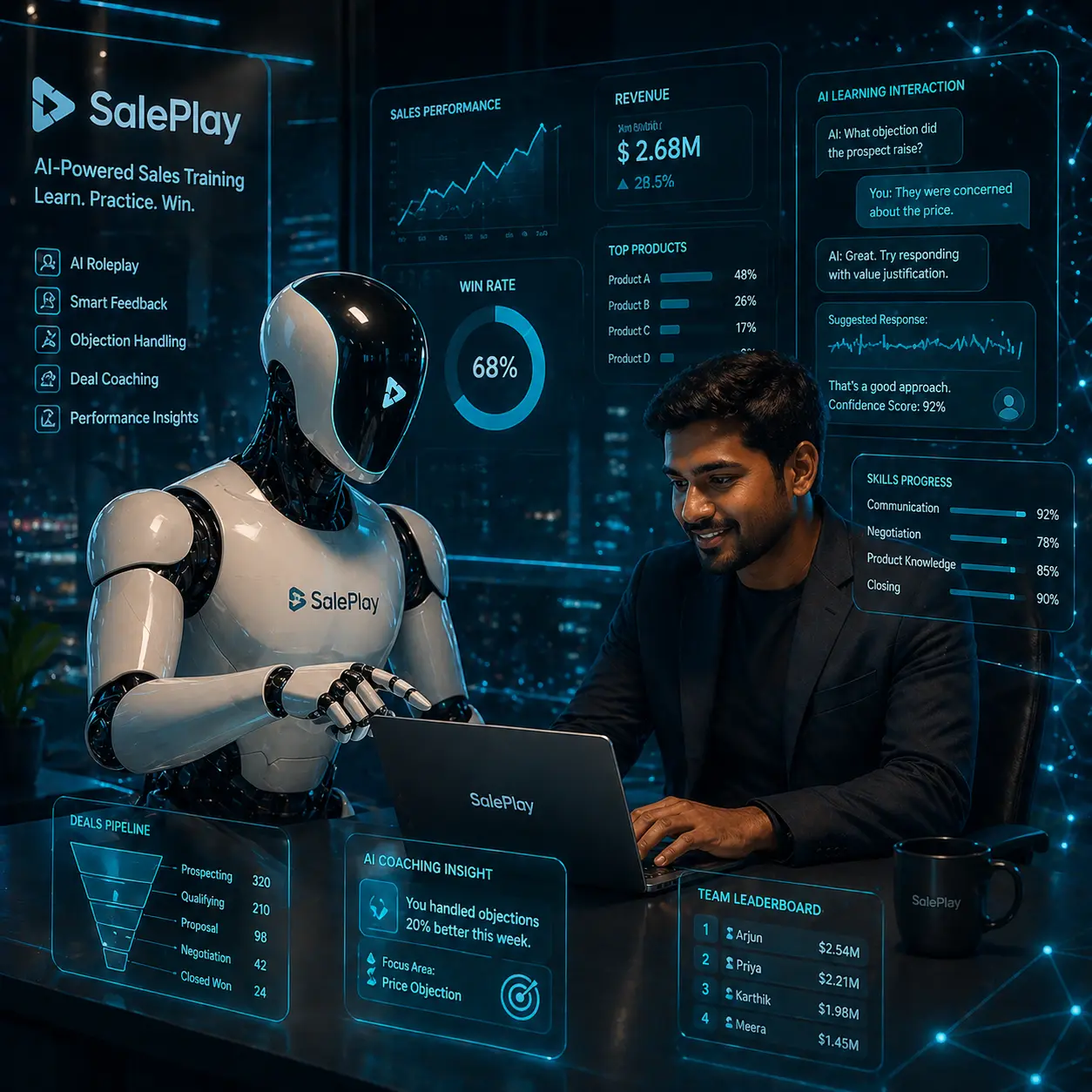
The Roleplay Renaissance
Sales roleplay has always been recognized as one of the most effective training methods. There's no substitute for actually practicing a conversation rather than just reading about it or watching someone else. Yet despite its proven value, roleplay has remained underutilized in most organizations for one simple reason: it's hard to do at scale.
AI is changing that equation. But as AI roleplay tools become more sophisticated, a natural question emerges: should AI replace human roleplay, or complement it? The answer, like most things in sales, is "it depends."
The Case for Human Roleplay
Human roleplay has strengths that AI cannot fully replicate, at least not yet:
Nuance and Unpredictability
Experienced human roleplay partners bring genuine unpredictability to practice sessions. They can pick up on subtle cues, change direction mid-conversation, and create the kind of uncomfortable moments that actually happen in real sales calls. A skilled manager playing a difficult prospect can test a rep's composure in ways that current AI struggles to match.
Relationship and Trust Building
Roleplay with a manager or peer isn't just skill practice; it's relationship building. These sessions create shared experiences, demonstrate vulnerability, and build the trust that effective coaching requires. A rep who regularly roleplays with their manager develops a coaching relationship that extends beyond any single practice session.
Contextual Judgment
Human coaches can make judgment calls that AI cannot. They know when to push harder and when to offer encouragement. They understand the specific deal a rep is worried about and can tailor the practice accordingly. They can sense when a rep is getting discouraged and adjust the difficulty.
Mentorship and Career Development
The best roleplay sessions aren't just about the immediate skill being practiced. They're opportunities for broader mentorship: sharing war stories, discussing career development, building confidence. This mentorship dimension is uniquely human.
The Case for AI Roleplay
AI roleplay has different but equally compelling strengths:
Unlimited Availability
AI never has a conflicting meeting, a bad day, or a vacation. Reps can practice at 6 AM before their first call, at 10 PM after a tough day, or anytime in between. This availability transforms roleplay from an occasional event into a consistent habit.
Perfect Consistency
AI applies the same standards and criteria every time. There's no variation based on the coach's mood, energy level, or personal biases. This consistency provides a reliable baseline for measuring improvement over time.
No Judgment or Politics
Some reps hesitate to practice difficult scenarios with their manager because they don't want to look incompetent. With AI, there's no career risk in struggling. This psychological safety encourages more practice on genuinely challenging scenarios.
Infinite Patience
AI will practice the same objection handling 50 times without getting bored or frustrated. For reps who need extensive repetition to build confidence on a particular skill, this patience is invaluable.
Detailed Analytics
AI can track performance across hundreds of practice sessions, identifying patterns and trends that human observation would miss. This data enables more precise skill diagnosis and development planning.
A Direct Comparison
| Factor | Human Roleplay | AI Roleplay |
|---|---|---|
| Availability | Limited by schedules | 24/7, on-demand |
| Consistency | Varies by coach | Perfectly consistent |
| Scalability | One coach, one rep at a time | Unlimited simultaneous sessions |
| Psychological Safety | May feel risky | Zero judgment |
| Nuance | Highly nuanced | Improving but limited |
| Relationship Building | Strong | None |
| Adaptability | Can adjust in real-time | Follows programmed scenarios |
| Feedback Quality | Subjective but contextual | Objective but may miss context |
| Cost per Session | High (manager time) | Low (software subscription) |
| Practice Volume | Limited | Unlimited |
When to Use Each Approach
Use AI Roleplay When:
- Building foundational skills: New reps learning basic objection handling, discovery questions, or product positioning benefit from high-volume AI practice.
- Preparing for specific scenarios: Before a big call, quick AI practice on likely objections helps reps warm up and feel confident.
- Drilling specific weaknesses: When a rep needs to improve a specific skill, AI enables the repetition required without monopolizing manager time.
- Onboarding at scale: Large hiring classes can all practice simultaneously, accelerating ramp without proportional increases in coaching resources.
- Maintaining skills during busy periods: When managers are consumed by quarter-end activities, AI keeps skill development happening.
Use Human Roleplay When:
- Developing advanced skills: Complex negotiations, executive conversations, and nuanced objection handling benefit from human sophistication.
- Coaching on specific deals: When a rep is preparing for an important meeting with a known prospect, human roleplay can incorporate specific context and strategy.
- Building coaching relationships: Regular human roleplay sessions strengthen the manager-rep relationship and create mentorship opportunities.
- Assessing readiness: Before certifying a rep on a new product or process, human evaluation provides confidence that AI assessment alone may not.
- Addressing confidence issues: When a rep is struggling with confidence, human encouragement and support may be more valuable than perfect practice.
The Hybrid Approach
The most effective organizations don't choose between AI and human roleplay. They use both strategically:
AI for Volume, Human for Depth
AI handles the high-volume practice that builds fundamental skills and maintains proficiency. Human coaches focus on complex scenarios, strategic preparation, and relationship building. This division plays to each approach's strengths.
AI for Diagnosis, Human for Prescription
AI can identify specific skill gaps through consistent assessment. Human coaches then design targeted development plans and provide the contextual coaching that addresses root causes.
AI for Practice, Human for Certification
Reps practice extensively with AI before demonstrating competency to a human coach. This ensures that valuable human coaching time is spent on refinement rather than basic skill building.
AI Between Human Sessions
Human coaching sessions happen weekly or bi-weekly. AI fills the gaps, ensuring continuous practice between human touchpoints.
Why It's Not Either/Or
The debate over AI versus human roleplay creates a false dichotomy. The real question isn't which approach is better; it's how to combine them effectively.
Human coaching without AI is limited by scale. Most managers can realistically conduct 2-3 roleplay sessions per rep per week, often less. That's not enough repetition to build skills efficiently.
AI without human coaching misses the relationship, judgment, and mentorship dimensions that make coaching transformative. Reps need human connection and guidance, not just practice reps.
The winning formula uses AI to dramatically increase practice volume while preserving human coaching for the moments that require human qualities. Your managers become more effective because they're focused on high-value coaching activities, and your reps develop faster because they're practicing constantly. To understand this scalability challenge better, read Why Manager-Led Roleplay Doesn't Scale. For implementation guidance, see How to Use AI to Scale Sales Coaching.
Key Takeaways
- Human roleplay excels at nuance, relationship building, and contextual judgment - but it does not scale
- AI roleplay provides 24/7 availability, perfect consistency, zero judgment, and infinite patience
- Use AI for building foundational skills, drilling weaknesses, and onboarding at scale
- Use human roleplay for advanced skills, deal-specific coaching, and building coaching relationships
- The hybrid approach: AI for volume and diagnosis, human coaches for depth and prescription
- Combine both approaches strategically - AI between human sessions ensures continuous practice
Don't ask whether to use AI or human roleplay. Ask how to use both to create a coaching program that's greater than the sum of its parts.
Ready to practice what you learned?
Turn knowledge into muscle memory with AI-powered roleplay.
Start Practicing Free